Evaluating Machine Direction Stiffness Anisotropy in High Speed Folding Boxboard Converting
Folding boxboard machine direction stiffness anisotropy governs carton opening force and high-speed feeder reliability, demanding strict ratio limits on orders.


Wire
Fibre orientation during headbox delivery determines the mechanical directional split of multi-ply folding boxboard. As stock slurry flows through the slice opening onto the forming fabric, the velocity differential between the liquid jet and the wire mesh aligns individual cellulose fibres parallel to the machine direction. Matching jet velocity to wire speed produces a random fibre orientation and isotropic sheet properties, while raising or lowering the jet-to-wire velocity ratio introduces drag or rush that forces slender softwood kraft and mechanical fibres to align along the axis of web movement.
This physical alignment alters flexural rigidity along orthogonal axes, with machine direction stiffness exceeding cross direction stiffness by ratios ranging from 1.2:1 up to 3.0:1 in commercial folding boxboards. Multi-ply machine architectures amplify this structural divergence by varying stock composition across individual forming units ~ using bleached chemical pulp outer layers to handle tensile stress during flexure while groundwood or chemi-thermomechanical pulp middle layers maintain caliper and bulk.

Fibre Hydration and Jet Speed Ratios
Stock slurry exits the slice opening under hydraulic pressure onto the moving mesh substrate. Micro-turbulence generators inside modern hydraulic headboxes disrupt fibre flocculation, yet the primary driver of directional alignment remains the speed differential at the landing point. A jet-to-wire ratio of 0.95 creates drag that pulls wet fibres into longitudinal alignment, whereas a ratio of 1.05 creates rush, forcing them into a similar axial orientation.
Refining intensity further modulates this behaviour: highly refined chemical pulp fibres have thinner walls and greater wet flexibility, packing tightly along the machine direction under hydrodynamic shear.

Ply Architecture in Multi Layer Boxboard
Virgin bleached chemical pulp forms the top print layer, while chemi-thermomechanical pulp provides bulk inside the middle core. The flexural rigidity of a multi-ply structure follows the beam equation, scaling with the modulus of elasticity of the outer layers and the cube of total sheet thickness. Concentrating high-modulus chemical pulp in the outer plies maximizes bending resistance per unit weight, and aligning those outer fibres parallel to the production axis maximizes machine-direction stiffness, creating an asymmetric rigidity profile across the finished board web.
Whether high-speed forming heads can maintain uniform fibre orientation across wide machine trims at speeds exceeding eight hundred meters per minute remains an open engineering challenge.

Deflection
Standardized mechanical testing instruments measure the flexural moment of paperboard under controlled physical displacement. Laboratory evaluation relies on two principal bending geometries: the two-point bending force method and the dynamic resonance frequency method. Because operating parameters vary across international standards, discrepancies often arise between laboratory test certificates and physical board performance on high-speed packaging lines.
Relative humidity during conditioning alters the moisture content of hydrophilic cellulose, softening internal hydrogen bonds and reducing overall flexural rigidity. ISO 187 specifies specimen conditioning at twenty-three degrees Celsius and fifty percent relative humidity. Testing unconditioned samples directly from production bays yields inflated stiffness values that collapse when stock reaches ambient converting environments.
Static Bending Moment Protocols
Instruments operating under two-point bending force evaluate board rigidity at specified angular limits. ISO 2493-1 defines two-point bending at a fifteen-degree deflection angle over a fifty-millimeter free span, while ISO 5628 outlines parameters for five-degree optical deflection measurements. Taber instruments use fifteen-degree flex angles, whereas L&W testers record five-degree bending forces.
At fifteen degrees of deflection, multi-ply boards frequently exceed the elastic limit of the middle CTMP layer, initiating internal micro-delamination; measuring at five degrees captures elastic deformation without disturbing ply structural integrity.
Conditioning test specimens at twenty-three degrees Celsius and fifty percent relative humidity per ISO 187 establishes standard baseline values for fifteen-degree bending moments.
- Condition test specimens at twenty-three degrees Celsius and fifty percent relative humidity for twenty-four hours.
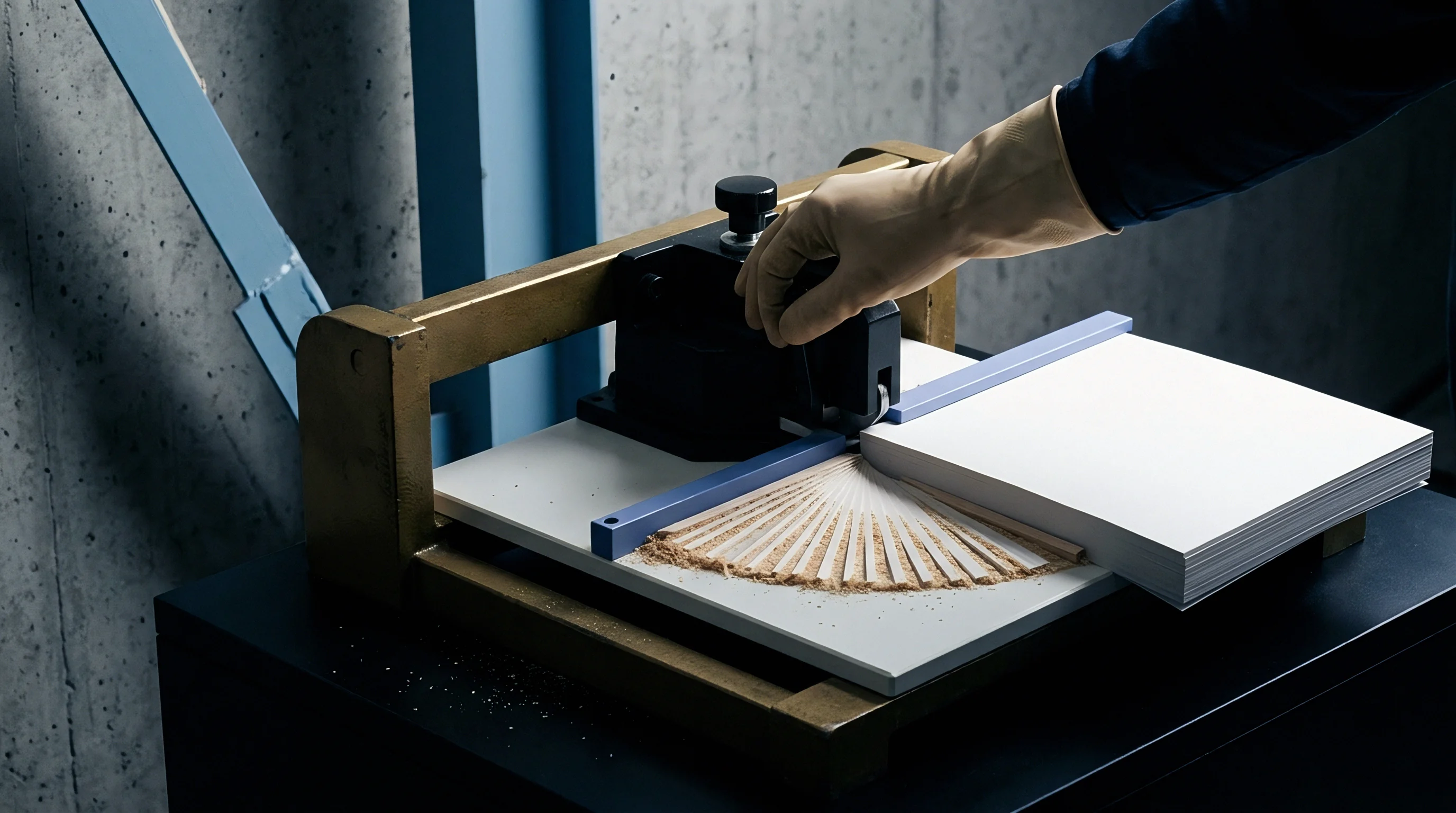
- Cut ten specimens in the machine direction and ten in the cross direction using a dual-blade precision cutter.
- Verify load cell zero calibration before clamping the specimen inside the pneumatic test jaw.
- Execute the bending sequence at two degrees per second to a maximum deflection of fifteen degrees.
- Record the peak force value in millinewtons and calculate the geometric mean anisotropy ratio.

Resonance Rigidity Measurements
Non-destructive dynamic testing calculates flexural stiffness through sound propagation across the sheet. ISO 5629 details resonance methods where an electromagnetic transducer induces sonic flexural waves in a clamped paperboard strip. Resonance frequency correlates directly with bending stiffness and basis weight, bypassing the physical clamping deformation errors inherent to two-point bending jaws.
These dynamic methods highlight local anisotropy variations across machine trims that static bench tests routinely average out.
| Standard Method | Bending Angle | Free Span Length | Conditioning Atmosphere | Measured Anisotropy Impact |
|---|---|---|---|---|
| ISO 2493-1 | 15 degrees | 50 mm | 23 C / 50% RH | Captures plastic core strain and inner ply shear failure |
| ISO 5628 | 5 degrees | 50 mm | 23 C / 50% RH | Measures pure elastic bending resistance without ply shear |
| TAPPI T 556 | 15 degrees | 50 mm | 23 C / 50% RH | Standard American two-point bending force measurement |
| ISO 5629 | Dynamic Resonance | Variable Span | 23 C / 50% RH | Evaluates non-destructive sonic stiffness modulus across axes |
A board displaying high cross-direction rigidity consistently resists panel bulge under vertical compression.

Blank
High-speed folder-gluers transform flat die-cut paperboard shapes into collapsed cartons at speeds reaching one hundred thousand units per hour. At these rates, physical board anisotropy directly controls line efficiency, scoring precision, and final package squareness. The orientation of machine-direction stiffness relative to the carton’s main panel fold lines determines whether blanks pass cleanly through rotary folding belts or stall inside compression channels.
When main fold lines align parallel to the machine direction, low cross-direction stiffness simplifies longitudinal folding but leaves side panels susceptible to bowing during product filling. Conversely, aligning main fold lines perpendicular to the machine direction demands substantially higher creasing force to break longitudinal fibre strength.
Crease Formation and Score Resistance
Penetration of male creasing rules into female matrix channels creates local delamination inside the middle plies. This controlled internal damage establishes a hinge mechanism that reduces bending resistance along score lines. When creasing cuts across high-stiffness machine direction fibres, score breakdown requires precise rule depth adjustment to avoid splitting the top coated chemical pulp layer; inadequate crease depth leaves high residual score stiffness, forcing folded panels to spring back after exiting side-seam glue belts.
Matching crease depth to inner ply delamination depth ensures clean score folds without face cracking.
Carton Opening Resistance and Panel Bulge
Automated packaging line suction arms apply opposing force to erect flat folded cartons into rigid rectangular geometry. The force required to open a flat blank depends directly on the ratio between main panel flexural stiffness and score line resistance. If cross-direction stiffness runs too low relative to high machine-direction score resistance, flat carton panels bow under vacuum suction instead of hinging cleanly at the creased corners, leading to incomplete square-up and immediate line stoppages.
- Score line fracture occurs when high machine-direction stiffness limits crease elongation during rapid ninety-degree folding sequences.
- Carton springback forces side-seams open before hot-melt adhesive sets inside the compression belt section.
- Panel bowing distorts rectangular carton geometry under high vertical stack loading in automated secondary packaging stations.
- Erection failure halts high-speed insertion lines when cross-direction rigidity exceeds suction picker force capabilities.
| MD:CD Stiffness Ratio | Caliper (um) | Gluer Line Speed (units/hr) | Opening Force (N) | Jam Rate (ppm) |
|---|---|---|---|---|
| 1.3 : 1 | 350 | 95,000 | 1.2 | 120 |
| 1.8 : 1 | 350 | 92,000 | 1.6 | 280 |
| 2.4 : 1 | 350 | 84,000 | 2.3 | 850 |
| 3.0 : 1 | 350 | 71,000 | 3.4 | 2,400 |
Misaligning board orientation on high-speed lines produces jam rates that destroy production margin and force line shutdowns.

Feeder
Vacuum suction cups and mechanical friction belts extract individual paperboard blanks from the bottom of stacked hoppers. High-speed feeders rely on precise planar flatness and predictable structural rigidity to pull single blanks cleanly into registration chains. Variations in machine-direction stiffness anisotropy alter blank deflection profiles under suction force, introducing feeding instability at processing speeds above twelve thousand sheets per hour.

How Does Anisotropy Ratio Alter High Speed Feeder Reliability?
Unbalanced directional rigidity causes flat blanks to bow under vacuum pressure, breaking pneumatic suction seals. When cross-direction stiffness falls below minimum threshold levels, the leading edge of the lowest blank in the hopper sags downward between support runners. This sag exposes the trailing edge to interference from trailing suction cups, triggering misfeeds or double-sheet pickup.
Including ISO 2493 stiffness ratio tolerances in mill purchase agreements creates binding quality benchmarks for delivered reels.
- Vacuum pressure calibration maintains consistent suction force across varying sheet weights without drawing multiple blanks.
- Hopper gate clearance prevents double-sheet entry while eliminating edge scuffing on sensitive coated surfaces.
- Air blast adjustment floats the bottom sheets to lower friction during high-speed extraction sequences.
Register Accuracy and Side Drag
Lateral movement along side-register guides requires consistent structural rigidity across the advancing front edge. Sheets featuring low stiffness across their leading edge buckle upon contacting mechanical side-aligning stoppers, causing angular skew before printing or die-cutting stations. Maintaining an anisotropy ratio below 2.0:1 delivers sufficient cross-machine rigidity to prevent edge compression during high-speed positioning cycles.
High feeder jam rates stem from unconditioned converting plant humidity as well as variations in jet-to-wire stock distribution.
Ledger
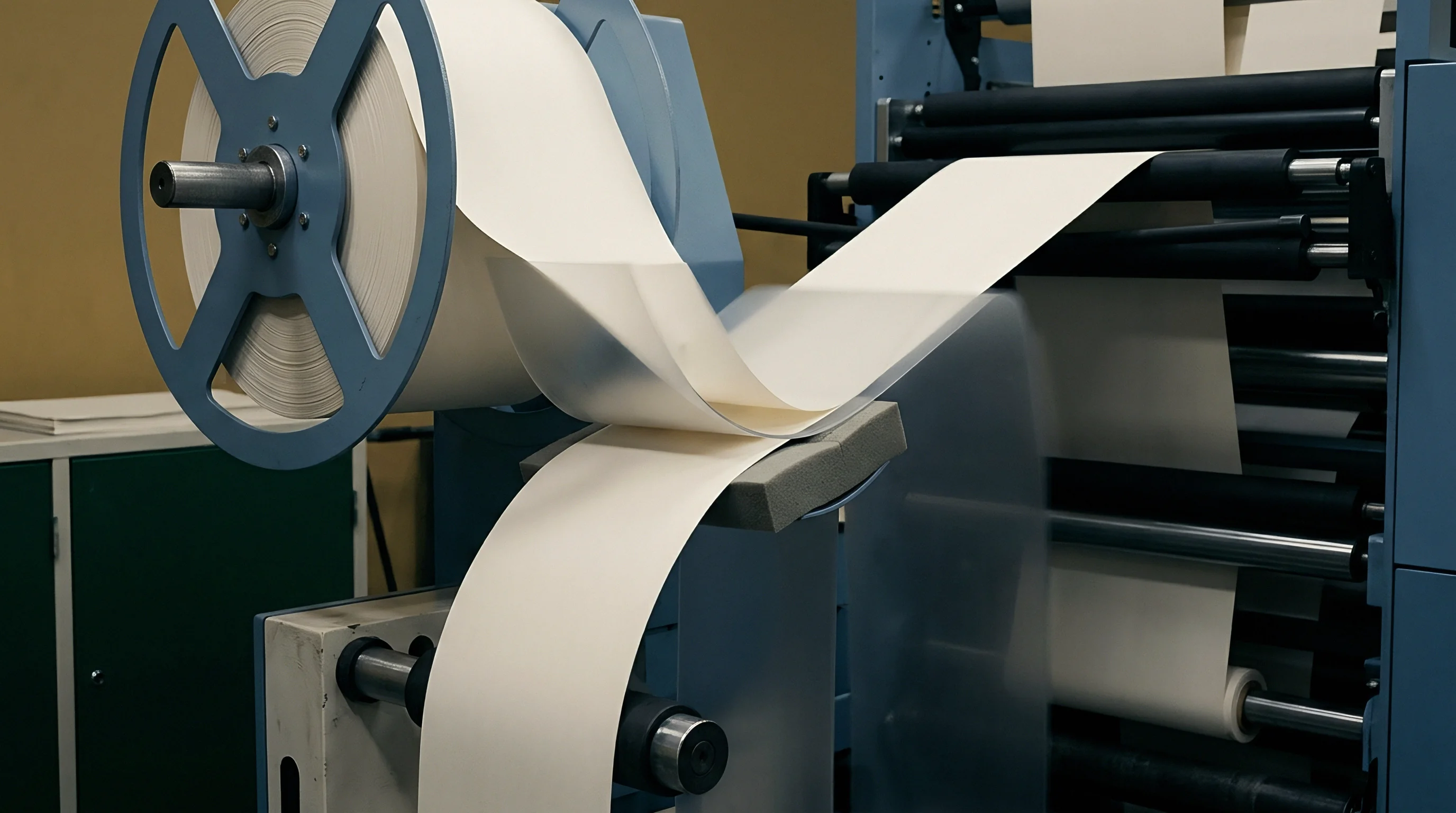
Substrate specification decisions directly drive the overall financial balance of carton manufacturing operations. Buying folding boxboard by metric tonnage while converting and selling finished products by individual sheet unit area creates direct economic leverage around caliper, basis weight, and flexural stiffness. Optimizing directional stiffness ratios enables converters to select lower grammage boards without sacrificing carton structural performance, unlocking substantial yield savings across long production runs.
Yield Calculations and Parent Sheet Grain Layout
Interlocking blank geometries across parent sheet layouts balance knife trim waste against required grain direction. Placing blanks parallel to the web motion maximizes sheet nest density but locks panel folding lines into a fixed orientation relative to machine direction anisotropy.
Consider a forty-tonne order of folding boxboard at twelve hundred Euros per tonne, under a baseline specification of three hundred fifty micrometers caliper at a basis weight of two hundred eighty grams per square meter. An optimized high-bulk CTMP boxboard grade yielding three hundred fifty micrometers caliper at two hundred fifty grams per square meter maintains an equivalent machine-direction bending stiffness of eighteen millinewton-meters, priced at twelve hundred fifty Euros per tonne.
On the baseline grade, forty tonnes yields 142,857 square meters of board. At a blank surface area of 0.08 square meters per carton, this order generates 1,785,712 individual blanks at a total cost of 48,000 Euros, or 26.88 Euros per thousand blanks. On the optimized high-bulk grade, forty tonnes yields 160,000 square meters of board, producing 2,000,000 blanks at a total cost of 50,000 Euros, or 25.00 Euros per thousand blanks.
Despite the higher price per tonne, landed blank cost drops by 1.88 Euros per thousand units, generating a net saving of 3,760 Euros across the forty-tonne order.
Buying paperboard by the metric tonne requires calculating material yield on the basis of finished carton surface area.

Downgauging Economics and Material Substitution
Replacing heavy chemical pulp layers with high-bulk CTMP lowers total order tonnage while preserving required bending resistance, with yield improvement scaling inversely to basis weight reductions. When machine-direction stiffness anisotropy is kept within tight upper boundaries, converters can safely reduce board caliper without incurring feeder misfeeds or carton erection failures on customer packaging lines.
| Specification Option | Basis Weight (g/m²) | Caliper (um) | Price (€/tonne) | Blank Yield per Tonne | Cost per 1,000 Blanks (€) |
|---|---|---|---|---|---|
| Standard Virgin FBB (Baseline) | 280 | 350 | 1,200 | 44,642 | 26.88 |
| Optimized High-Bulk FBB | 250 | 350 | 1,250 | 50,000 | 25.00 |
| Downgauged High-Anisotropy FBB | 230 | 320 | 1,280 | 54,347 | 23.55 |
| Uncontrolled Anisotropy Recycled Board | 290 | 350 | 1,050 | 43,103 | 24.36 |
Incorporating an explicit DIN 53121 stiffness anisotropy clause into the master supply agreement obligates the mill to reimburse converting downtime costs resulting from out-of-spec ratio drift.