Dynamic Mechanical Delamination Mechanisms across Mechanical Core Interfaces under High-Speed Converting Shear
Dynamic high-speed shear delamination across mechanical board cores occurs when strain rates exceed interfacial starch adhesion, requiring dynamic shear specification over static Scott bond values.


Core
In multi-ply paperboard, z-direction density profiles show the largest porosity variations within the central mechanical furnish layers. In a 350 g/m² folding boxboard produced on a triple-fourdrinier or multi-former machine, the core ply usually consists of thermo-mechanical pulp or stone groundwood sandwiched between bleached chemical pulp outer liners. Interfacial cohesion relies on physical fibre entanglement, hydrogen bonding across the wet-web consolidation zone, and cationic corn starch sprayed between forming wires at dry solids concentrations of 1.5 g/m² to 3.0 g/m².
If wet-end dewatering rates on individual wires vary by more than five percent across the machine width, fines and filler migrate toward the wire side of each ply, leaving a layer depleted of long softwood fibres right at the ply junction.
Mechanical core plies made from unbleached recycled furnish contain short, hornified fibres that swell poorly during re-wetting, making interlayer bonding heavily dependent on surface starch film integrity. Microscopic density voids along this interface act as stress raisers under transient mechanical loads. Where filler accumulates, the local elastic modulus drops sharply, and moisture content gradients across the sheet thickness worsen the mechanical imbalance during web transport.
Low core bulk increases interfacial stiffness gradients across adjacent board plies.
Fibre alignment in the core ply follows the orientation set by the headbox contraction ratio and wire speed ratios. Machine-direction alignment produces an anisotropic ratio where tensile strength along the web length exceeds cross-direction strength by a factor of 2.2 to 2.8. Out-of-plane shear strength ~ often called z-direction shear ~ correlates poorly with machine-direction tensile performance.
Under rapid loading, the dynamic interface between the mechanical core and chemical outer plies shows several distinct micro-structural failure mechanisms:
- Interfacial Fines Stratification reduces available hydrogen bonding sites because short broken cell wall fragments occupy the contact area without establishing structural cross-ply entanglements.
- Starch Film Crystallization creates brittle boundaries along the core junction when jet applicators operate above 65 degrees Celsius without precise solids monitoring.
- Density Step Discontinuities emerge between high-yield mechanical pulp plies and refined chemical pulp liners, creating sharp stiffness jumps that concentrate shear forces during bending.
- Moisture Entrapment Pockets slow down water vapor evacuation during high-speed drying cycles, generating localized steam micro-blisters that detach the core from the top liner.
Multi-Ply Structural Density Gradients
Gamma-ray absorption density profiles across the sheet section reveal steep gradients between adjacent plies. A low-density mechanical core with a bulk value of 1.8 cm³/g sits right next to a chemical pulp liner exhibiting a bulk of 1.1 cm³/g. This density jump creates a sharp plane of strain concentration during mechanical bending.
High-speed web handling forces outer plies into tension while compressing the inner core, forcing the interface to absorb inter-ply slip through elastic strain until shear stress exceeds the local hydrogen bond energy.
Sheet consolidation strategies frequently favor surface smoothness for printing over interfacial strength. Elevating wet-press shoe pressure densifies the outer faces while crushing mechanical pulp core fibers, lowering overall sheet bulk. That loss of core thickness reduces the moment of inertia, requiring higher grammage to maintain bending stiffness.
Anyone specifying board grades must balance outer liner calender density against the inter-ply bond strength required for converting line survival.

Interlayer Starch Hydrocolloid Distribution
Interlayer spray systems apply cooked starch suspensions directly onto the wet web before plies join in the press section. Effective adhesion requires a continuous hydrocolloid gel network across the boundary. Low spray pressure leaves dispersion gaps and unbonded dry patches measuring between 50 and 200 micrometres across, whereas overspraying creates a gelatinous layer that slows water drainage and causes wet crushing under primary nip compression.
Starch solution viscosity governs penetration depth into the fiber network. A starch solution running below 50 mPa·s at application temperature migrates excessively into the porous mechanical core, leaving insufficient polymer at the actual contact interface. A solution exceeding 150 mPa·s forms a discrete film that fails to anchor into either ply network.
Dynamic delamination in downstream processing tracks directly to these interfacial starch application failures.
Substrates specified without strict core ply bond standards fail during converting line speed accelerations, causing catastrophic web breaks and unscheduled press stops.

Clamp
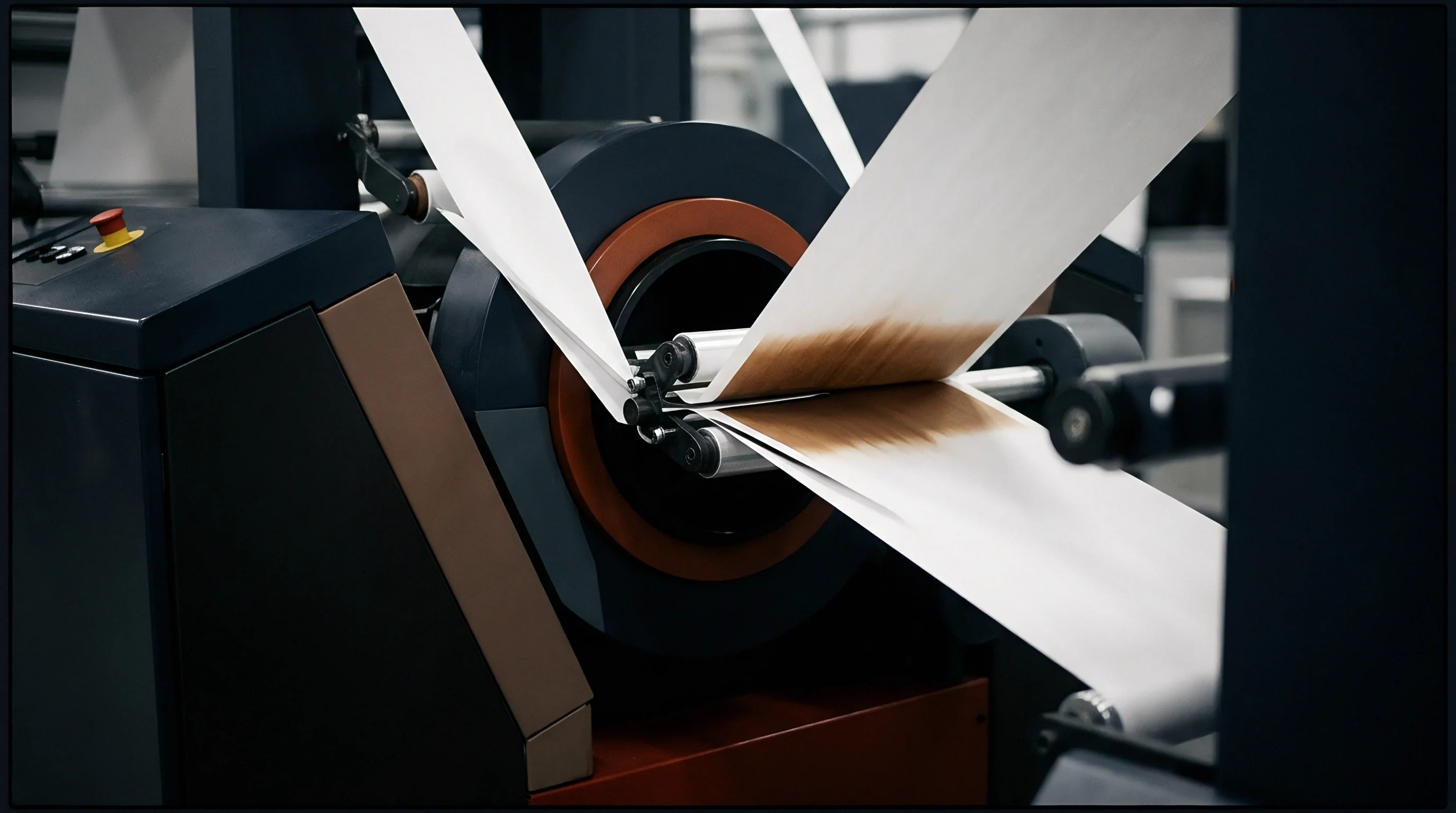
Converting equipment forces paperboard through extreme mechanical deformations in milliseconds. Rotary die-cutting stations, folding-gluing nips, and scoring matrices apply combinations of compressive, tensile, and shear loads simultaneously. Entering a rotary die nip at 400 metres per minute, a multi-ply web undergoes intense localized compression from upper and lower anvil rolls across a nip width under two millimetres.
The instantaneous pressure spike reaching 15 MPa drives out-of-plane material displacement, forcing adjacent plies to move past each other at varying relative velocities.
Shearing action peaks along the interface between plies of contrasting elastic moduli. Mechanical core layers compress easily under the die blade, while stiff chemical outer layers resist localized deformation. This resistance generates a high-velocity shear wave that propagates laterally along the web.
When local shear stress exceeds the dynamic yield strength of the core interface, micro-cleavage initiates before the cutting edge fully penetrates the board structure.
At converting web speeds above 450 metres per minute, peak z-direction shear rates at the core interface exceed 1200 reciprocal seconds under a 0.15 millimetre nip compression.

Dynamic Shear Strains in Rotary Die Cutting
Rotary die-cutting tools rely on precise anvil gaps to cut through upper plies while scoring lower plies. Geometric clearance between the knife edge and counter-anvil forms a localized deformation zone dominated by high strain rates. At industrial conversion rates, material passes through this deformation zone in less than 0.5 milliseconds, shifting the board’s physical response from viscoelastic flow to brittle elastic fracture.
Shear rate severity increases linearly with web velocity and inversely with nip width. Rapid web acceleration shifts the failure mode from clean fiber severance to interlayer delamination propagation. The mechanical core interface yields first because its porous, low-density network possesses lower dynamic fracture toughness than dense outer liners.
- The advancing rotary die blade impacts the top chemical liner, establishing a triaxial compression state directly beneath the blade tip.
- Compressive stress propagates vertically into the mechanical core ply, inducing lateral outward displacement of short groundwood fibers.
- Differential displacement between the rigid top liner and expanding core generates peak interfacial shear stress ahead of the blade tip.
- Micro-cracks form within the starch-depleted boundaries at the core junction when shear strain rates exceed material relaxation capacity.
- Interfacial micro-cracks coalesce into a continuous delamination front that propagates up to three millimetres beyond the cut edge.
Web Tension Variations across High-Speed Nips
Tension variations across high-speed converting lines induce cyclic inter-ply shearing. Draw rolls and pull nips control web movements through continuous adjustments, sending high-frequency tension transients down the web. A rapid tension spike of 50 N/m increases internal shear stresses within the mechanical core, particularly where the web wraps around small-diameter idler rolls.
Bending a multi-ply sheet over a curved surface generates shear stress proportional to sheet caliper and curvature radius. Small idler roll diameters amplify internal slipping forces between plies; if the roll radius falls below fifty times the sheet caliper, internal shear forces routinely overcome weak core ply bonds, causing latent internal delamination that manifests as surface blistering during carton erecting.
Converting failures are frequently attributed to web tension settings exceeding nominal limits, regardless of internal ply bond test scores.
Rupture
Fracture initiation in multi-ply structures follows crack growth mechanics modified for heterogeneous fibrous networks. When localized shear stress overcomes interfacial adhesion, energy dissipates through fiber pull-out, hydrogen bond breakage, and starch film cleavage. In static conditions, energy dissipation relies primarily on hydrogen bond breakdown across the fiber-to-fiber contact area.
Under high-speed dynamic shear, viscous friction between sliding fiber surfaces absorbs a significant portion of input kinetic energy.
Once critical energy release rates are surpassed, crack propagation speed along the core interface can exceed 200 metres per second. The crack path follows the path of least resistance, oscillating between the mechanical core boundary and adjacent starch film. High fines content along the wire side of the core ply provides a low-energy pathway for crack propagation, allowing delamination fronts to run long distances without arresting.
Where Do Interfacial Shear Fractures Initiate under Localized Strain?
Interfacial shear fractures initiate at microscopic structural flaws positioned along the density transition zone between plies. Initiation sites include unbonded starch spray voids, localized air pockets left by incomplete wet compression, and clusters of unrefined shives within the mechanical furnish layer. Stress concentrates at these geometric irregularities, creating local stress intensity factors that exceed the critical threshold long before nominal web tension reaches failure levels.
Topographical roughness variations on the wire side of forming plies also introduce structural stress raisers. When a rough core ply is coupled to a smooth chemical liner, contact occurs only at high asperities. Starch bridge failure across these isolated contact points releases strain energy, driving rapid crack propagation across surrounding unbonded gaps.
Standard ISO 16260 energy values overestimate dynamic high-speed converting shear resistance whenever filler content at the ply boundary exceeds twelve percent.
Energy Dissipation Mechanics at Ply Boundaries
The fracture energy threshold governing mode II shear delamination differs substantially from mode I tensile opening values. Mode II dynamic fracture energy incorporates both the energy required to create new surface area and the energy lost to plastic friction as rough fiber networks slide against one another. Higher mechanical pulp content increases surface friction due to rigid, unrefined lignin-rich fibers protruding into the interfacial zone.
The balance between elastic strain energy storage and viscous dissipation depends heavily on web moisture content and conversion temperature. Low moisture levels below five percent increase material brittleness, reducing plastic energy dissipation capacity and promoting rapid, low-energy fracture propagation. Conversely, elevated moisture levels above nine percent soften starch bonds, lowering the initial stress required to initiate inter-ply sliding.
| Substrate Grade | Core Furnish Composition | Caliper (µm) | Static Scott Bond (J/m²) | Dynamic Shear Fracture Energy (J/m²) | Critical Failure Strain Rate (s⁻¹) |
|---|---|---|---|---|---|
| Folding Boxboard (FBB) | 100% Thermo-Mechanical Pulp | 400 | 185 | 112 | 850 |
| Coated Recycled Board (CRB) | 100% Mixed Waste Deinked | 420 | 135 | 74 | 520 |
| Solid Unbleached Board (SUB) | Unbleached Softwood Kraft | 380 | 260 | 195 | 1400 |
| Solid Bleached Board (SBB) | 100% Bleached Hardwood/Softwood | 350 | 225 | 168 | 1150 |
Interfacial failure transitions depend on specific structural variables:
- Z-Direction Density Gradient controls the distribution of tensile and shear stresses between core layers and surface liners.
- Interfacial Fiber Orientation governs directional resistance to shear propagation along machine versus cross directions.
- Starch Gel Viscoelasticity determines energy absorption efficiency under fast dynamic shear pulses.
- Filler Retention Uniformity dictates the concentration of non-bonding inorganic particles at ply contact planes.
What fundamental strain rate threshold marks the absolute division between steady viscoelastic slip and catastrophic brittle delamination across recycled core interfaces?
Gauge
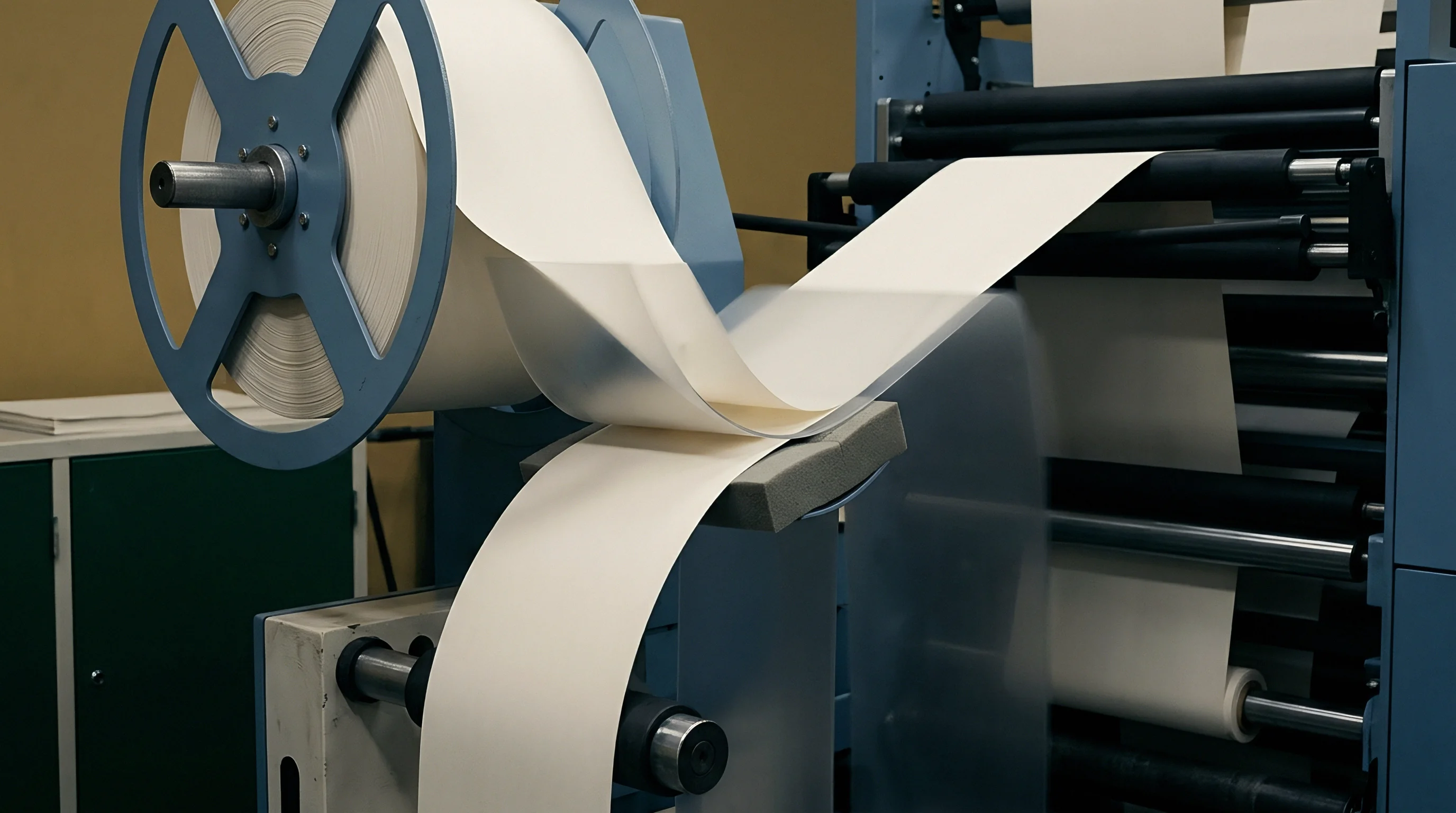
Evaluating multi-ply core interface strength requires testing methods that mirror industrial converting conditions. Standard laboratory ply-bond testing relies predominantly on the internal bond strength test, commonly referred to as the Scott Bond test according to TAPPI T 569 or ISO 16260. This method measures the energy required to rupture a paperboard specimen using a falling pendulum impact head striking an aluminum angle glued to the sheet surface.
The strain rate delivered by a standard pendulum impact head ranges between 10 and 30 reciprocal seconds.
Converting lines running at modern commercial speeds generate localized strain rates exceeding 1000 reciprocal seconds during rotary scoring and die-cutting. Static or low-strain testing methods fail to capture rate-dependent yield phenomena, frequently certifying paperboard reels that subsequently fail on high-speed packaging lines. Mill quality labs relying solely on standard Scott Bond metrics remain blind to dynamic shear vulnerabilities.
Delamination occurring during matrix stripping stems from high-frequency shear pulses rather than static z-directional tension.
Limitations of Standard Z-Direction Impact Testing
Standard pendulum impact testing forces specimen failure in a mixed mode dominated by z-direction tension. In converting machinery, delamination occurs primarily under localized high-speed shear stresses parallel to the ply interface. A board sample displaying an acceptable Scott Bond value of 180 J/m² can contain internal core defects that lead to failure under dynamic shear loads.
Specimen preparation for TAPPI T 569 introduces further measurement error. Pressing pressure applied to double-sided adhesive tape during sample mounting compresses mechanical cores, artificially elevating physical contact points and yield readings. The viscoelastic properties of the mounting tape absorb impact energy, skewing board fracture measurements by up to fifteen percent.

Dynamic Shear Characterization Protocols
Accurate prediction of converting line behavior requires dynamic z-shear testing apparatus capable of delivering controlled high-strain pulses. Modified split-Hopkinson pressure bar systems and high-speed servo-hydraulic test frames enable strain rates from 100 to 2000 reciprocal seconds. Measuring force displacement curves at these velocities isolates true dynamic shear modulus and interface fracture energy.
High-speed video analysis synchronized with dynamic force sensors tracks exact crack initiation timelines. Imaging reveals whether cleavage occurs within the starch interface layer or inside the mechanical core fibers. Identifying the precise rupture locus directs mill corrections toward furnish refining or starch application adjustments.
| Test Protocol | Governing Standard | Primary Failure Mode | Applied Strain Rate Range | Converting Correlation Reliability |
|---|---|---|---|---|
| Scott Bond Pendulum | TAPPI T 569 / ISO 16260 | Mode I Tensile / Mixed | 10 – 30 s⁻¹ | Low for High-Speed Die Cutting |
| Z-Direction Tensile | ISO 1924-2 / TAPPI T 541 | Pure Mode I Tensile | 0.01 – 0.1 s⁻¹ | Very Low for Shear Mechanics |
| High-Speed Z-Shear | Internal Mill Protocol | Pure Mode II Shear | 500 – 1500 s⁻¹ | High for Rotary Converting |
| Short-Span Compression | ISO 9895 / TAPPI T 826 | In-Plane Compressive Yield | 0.1 – 1.0 s⁻¹ | Moderate for Crease Scoring |
An effective dynamic ply-bond qualification specification includes clear technical constraints:
- Dynamic Strain Capacity must evaluate materials at or above 800 reciprocal seconds to reflect high-speed anvil interaction.
- Pure Shear Strain Isolation mandates testing apparatus that eliminates out-of-plane tensile moments during specimen loading.
- Controlled Environmental Conditioning requires testing strictly at ISO 187 standard atmosphere of 23 degrees Celsius and 50 percent relative humidity.
- Multi-Axis Force Recording measures simultaneous compressive and shear load components during specimen yield.
A standard purchasing contract addendum specifies that any delivered batch demonstrating dynamic high-strain shear values below 90 J/m² under ISO 187 conditioning triggers automatic lot rejection, regardless of static Scott Bond compliance certificates.
Scrap
Uncontrolled core delamination damages converting financial yield through unplanned material waste, machine downtime, and rejected finished goods. When a multi-ply board suffers internal interface separation during high-speed folding and gluing, damaged blanks jam folder-gluer feed hoppers. Clearing a jammed folder-gluer running at 500 cartons per minute takes an average of fifteen minutes, discarding hundreds of ruined blanks per incident.
The cost of core weakness extends far beyond raw material scrap. Blisters and internal voids that pass undetected through folder-gluers often fail on automated customer packing lines. Box corner opening failures cause high-speed cartoning machines to fault out, risking commercial claim penalties, re-sorting costs, and contract cancellation.

Financial Consequences of Core Interfacial Breakdown
To illustrate the financial impact of delamination, consider a 50-tonne converted carton production order using a 350 g/m² folding boxboard priced at 1,250 EUR per tonne landed, producing roughly 142,800 unit cartons. Under normal operating parameters, the line runs at 450 m/min with a baseline scrap rate of 1.5 percent.
When an off-spec board lot with inadequate core starch bonding enters production, dynamic shear failure forces press operators to drop line speed to 280 m/min to prevent continuous edge blister delamination. That speed reduction extends total run time from 10 hours to 16.1 hours, adding 6.1 hours of press time billed at an operating rate of 280 EUR per hour. Concurrently, matrix stripping tears and hopper jams elevate material scrap from 1.5 percent to 4.8 percent.
The extra 3.3 percent scrap consumes 1.65 tonnes of board, costing 2,062.50 EUR in wasted stock. Additional press operational charges total 1,708.00 EUR. Sorting, manual inspection, and packing line waste add another 1,200.00 EUR in direct labor.
Total financial damage for the 50-tonne lot reaches 4,970.50 EUR, representing an unrecoverable 8 percent surcharge on total material purchase cost. Specifying higher-performing core formulations adds a modest initial premium while securing baseline line performance.
Downgauge Arithmetic and Web Speed Tradeoffs
Sourcing teams frequently pursue downgauging programs to cut unit material costs, replacing a 350 g/m² board with a 330 g/m² alternative. If the thinner substrate achieves grammage reduction by lowering core density without maintaining starch application density, internal shear resistance decreases. The converting line loses operating speed headroom, converting potential savings into operational net losses.
A ten percent caliper reduction achieved via mechanical core crushing elevates shear stress concentrations within the inter-ply boundary during rotary scoring. If web speed must drop by twenty percent to keep shear stresses below the lowered rupture threshold, the converting cost per thousand sheets increases beyond the raw material yield savings. Core interface mechanics dictate the ultimate operational speed limit, placing a firm structural boundary on yield optimization strategies.
Optimizing multi-ply core interface performance requires balancing furnish selection, starch hydrocolloid chemistry, and converting shear mechanics. Sourcing decisions grounded in dynamic strain performance protect converting headroom, eliminate scrap spikes, and ensure predictable production economics across high-speed packaging operations.